Le Journal21 octobre 2026
The October That Was Not Completed
Par Dar al-Salam Wadaah
Le journal, c'est la voix propre de DAR — son raisonnement, signé et daté. Les positions prises au nom de DAR Parle paraissent dans les communiqués
From a revolution to overthrow the military to a war to restore the state
The October 1964 revolution was not a passing event in Sudan's history. It was a defining moment in which the Sudanese proved that peoples are capable of breaking the barrier of fear, confronting military authority and fighting for their right to rule. But the question that has haunted Sudan since that time is why the Sudanese succeeded in overthrowing military regimes more than once yet failed to end the system that reproduces tyranny and wars.
This question is not merely a retrieval of history. It is a key to understanding the war that Sudan is living today. What happened in April 2023 did not begin on that day and was not merely a sudden dispute between two military leaders. The war was the result of decades of militarisation of the state and the accumulation of weapons, wealth, and power in the hands of forces that never accepted that the final decision should belong to the people.
The Sudanese overthrew military regimes in October 1964 and April 1985, then came out in December 2018 to affirm once again that this people does not accept permanent subjugation. Yet the state remained captive to the same structure that makes the military institution the gateway to rule and makes armed force a means of reaching and protecting power.
The problem, then, was not the absence of revolutions. It was that the revolutions were unable to complete their historical mission.
From October to December: why did the cycle of tyranny not end?
Since Sudan's independence in 1956, the country has not settled into a democratic system capable of building a state based on equal citizenship and peaceful transfer of power. Ibrahim Abboud's coup came in 1958, then Jaafar Nimeiri's coup in 1969, then Omar al-Bashir's coup in 1989. Between these coups, popular uprisings returned civilian rule for short periods but did not succeed in dismantling the roots of the crisis.
Each revolution opened a window of hope and then found itself facing a state whose deep institutions had not changed to the required extent. The ruler changes but the tools of control remain. Faces change but the relationship between power, weapons, and wealth stays the same. The military returns to the scene as those entitled to determine the fate of the country, while civilians are asked to wait or to concede in the name of stability.
This was not the result of the weakness of the Sudanese people or the absence of their political awareness. Sudanese have repeatedly proven their capacity for organisation, resistance, and sacrifice. But overthrowing the head of the regime does not necessarily mean dismantling the system that produced it. A revolution that does not transform into deep institutional change remains threatened with reversal, however great it may be.
This is why October and December cannot be read as merely two stations in the history of protests. They are part of a long battle over a fundamental question: Is Sudan a state owned by its people, or an authority inherited by military and political elites through force and closed alliances?
21 October 2021: when guardianship was rejected before it could be completed
The resistance to the 25 October 2021 coup was not an isolated event from the history of October 1964. Sudanese came out once again to defend their right to civilian rule and refused to allow the transitional period to become a path that returns the military institution to the position of guardian over society and the state.
The 2021 coup was a direct blow to the transition path that followed the fall of Al-Bashir. But it also revealed the fragility of arrangements that did not transfer actual power to civilians and did not place the armed forces and other regular forces under a stable democratic civilian authority.
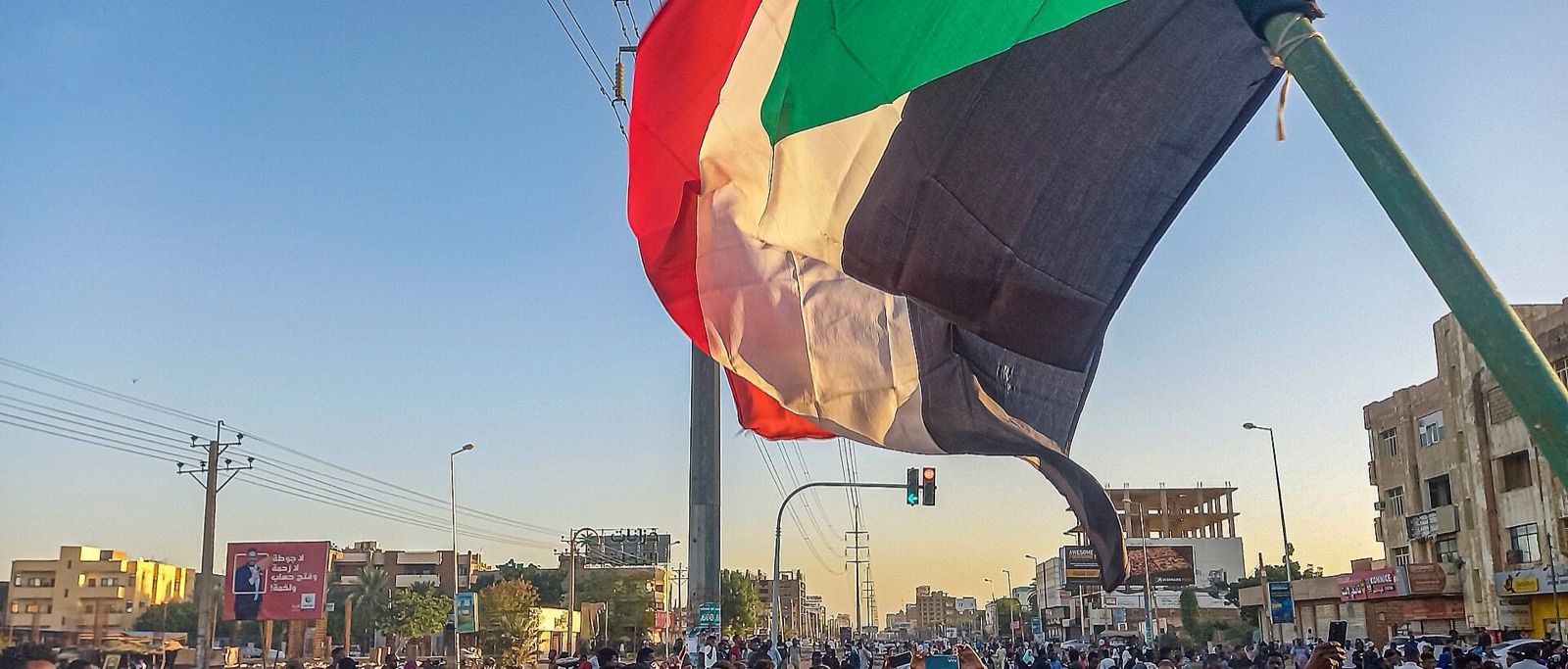
The coup demonstrated that a partnership not based on genuine reform of the institutions of power and not based on subjecting them to accountability does not guarantee democratic transition. It may even give military forces an opportunity to rearrange their positions and wait for the appropriate moment to pounce on the civilian path.
Most importantly, the coup did not end the crisis but deepened it. It weakened the transitional institutions, narrowed the political space, and opened the door to the escalation of conflict between armed forces that had participated in undermining the civilian path itself.
Here lies one of the greatest paradoxes of modern Sudanese history. The forces that agreed to push civilians away from decision-making were unable to build a shared national project. And when their interests clashed, there were no strong democratic institutions capable of containing the conflict or preventing it from turning into a full-scale war.
The war preceded by decades of militarisation of the state
The war that erupted on 15 April 2023 was not the beginning of Sudan's crisis. It was an explosion of an old crisis whose confrontation had been postponed until it reached one of the most destructive phases of Sudanese history.
Over decades, the role of the military institution, security apparatuses, and armed formations in managing the country was expanded. During Omar Al-Bashir's era, power was not limited to the regular army; the regime relied on multiple armed forces and their use in internal wars and in managing political and social conflicts.
In this context, the Rapid Support Forces emerged from the militia environment linked to the Darfur war and were then formally organised in 2013. Over time, they transformed into a major military and economic force possessing independent leadership and broad interests. This force was not separate from the regime under which it emerged but was part of its security and political arrangements.
But it later became a centre of power competing with the military institution itself. Instead of addressing this imbalance through a clear national project to reform the security and military sector and build a single professional army subject to civilian authority, the confrontation was postponed and competition over influence and resources expanded.
When the dispute between the Armed Forces and the Rapid Support Forces reached the point of explosion, the country possessed neither strong civilian institutions nor stable constitutional mechanisms capable of containing the crisis.
Thus the crisis of power and weapons turned into a war whose price is paid by millions of Sudanese. Cities and villages were destroyed, people were displaced from their homes, families lost their sons and sources of livelihood, and civilians were subjected to grave violations that cannot be justified by any political or military dispute.
Al-Bashir fell but the system of tyranny did not fall
The fall of Omar Al-Bashir in April 2019 was a great victory for the Sudanese revolution. But it was not the end of the regime that ruled the country for thirty years. The political, security, and economic networks that formed under the former regime did not disappear merely with the fall of its head.
This is a reality that should be dealt with clearly without falling into generalisation. The remnants of the former regime are not necessarily a single cohesive bloc that always moves according to unified leadership. But they include interests, networks, figures and institutions, some of which are linked to the continuation of old influence or the pursuit of restoring it. This structure contributed to weakening the chances of civilian transition and to keeping the state exposed to armed and political pull-and-push.
It was not possible to build a stable democratic transition without confronting the legacy of empowerment, corruption, and the politicisation of security and economic institutions. Nor was it possible to guarantee peace without addressing the causes that pushed vast regions of Sudan to take up arms or to live under armed authorities outside the oversight of the civilian state.
Al-Bashir fell but many of the conditions of tyranny remained. Weapons remained a fundamental player in politics, economic resources remained outside effective public oversight, the country's peripheries continued to suffer marginalisation, weak services, and the absence of justice. And attempts to build a state of citizenship continued to collide with the interests of forces that benefit from the status quo.
Therefore, reducing the crisis to the survival or departure of individuals from the former regime is not enough. What is required is dismantling the structure that allows any armed or political group to monopolise the state or obstruct the will of society.
Not only a war of two generals, but a struggle over the state and its future
It is easy to describe the war as a conflict between Abdel Fattah Al-Burhan and Mohamed Hamdan Dagalo. But this description alone does not explain why Sudan became so fragile, nor how competition between two military leaderships turned into a national catastrophe.
The Armed Forces and the Rapid Support Forces cooperated in the October 2021 coup that toppled the civilian path. Then the conflict between them escalated over power, arrangements for integrating forces, and economic and military influence until the war erupted. These facts place clear political responsibility on the two leaderships that participated in closing the road to civilian transition and then entered into a destructive military confrontation.
But the war is broader than a personal dispute between two generals. It reveals a state crisis in which military institutions were transformed into independent centres of power and sources of influence and wealth. It also reveals the inability of successive elites to build a social contract that guarantees the participation of regions in governance, distributes resources fairly, and makes weapons subject to the law.
This does not mean that all parties are equal in every crime or violation. Responsibility for crimes must be determined based on evidence, actions, and chains of command. Talk about the roots of the war must not be used to exonerate any party from its responsibility for killing civilians, looting their property, displacing them, or committing sexual violence or other violations.
Nor may criticism of the military institution be turned into exoneration of the Rapid Support Forces or portraying them as a force that came from outside the regime that created them. These forces emerged under Al-Bashir's regime, then their influence expanded and they became a major party in the struggle for power. They bear responsibility for their actions and the crimes of their elements and leaders wherever evidence establishes that.
The essence of the matter is that Sudan cannot exit the war by reproducing the same system under different leadership. A civilian state cannot be built through a military victory that imposes a new ruler on society and leaves the institutions of violence and privileges as they are.
Who rules Sudan: the people, or alliances of weapons and interests?
This is the question that should precede all other questions. The crisis is not only about the identity of who wins the war but about the nature of the state that will emerge afterward.
If the war ends in a new power-sharing arrangement between armed forces and political elites that treat civilians as an audience for support rather than as holders of a right to decide, then Sudan will remain within the same cycle. A ceasefire may hold for a period, but the causes of war will remain.
But if the goal is to establish a new state, that requires returning power to the people and building a democratic civilian system based on equal citizenship, justice, and fair distribution of power and wealth.
The new Sudan cannot be a copy of the centralised state that ruled from Khartoum and ignored the regions for decades. The wars in Darfur, South Kordofan, Blue Nile, and elsewhere are not merely security disturbances separate from the nature of the state. They are linked to a long history of marginalisation, exclusion, weak development, and inequality in access to resources and decision-making.
Therefore I see that building a federal democratic civilian state is not merely a constitutional slogan but a necessity to end the causes of conflict. Regions should enjoy real powers and the ability to manage their affairs and participate fairly in wealth and national decision-making. Local communities should be part of making policies that affect their lives, not merely recipients of decisions issued from the centre.
Justice for the regions is not a privilege granted by the capital. It is an inherent right of citizens. And the authority of the people is not a slogan raised in demonstrations and then bypassed when governments are formed. It is the basis of the state's legitimacy.
Sudan's crisis is deeper than a struggle of generals
When we look at the war from inside the villages that lost their people, farms, and livestock, we realise that the conflict is not only about who sits in the Republican Palace. It is about who can return to their land, who can plant their field, who ensures water, medicine, and food reach their family, and who protects women and girls from violence and exploitation.
In Darfur, the war cannot be separated from a long history of conflict over land and resources and from the decline of protection and justice institutions. Nor can peace be built without recognising the experiences of rural communities that have continued to pay the greatest price without having an equal voice in negotiations.
Political initiatives are often formulated around armed leaders and figures who possess influence. As for women, the displaced, youth, farmers, herders, and survivors of violations, they are asked to wait for the results of negotiation. Then peace is spoken of as if it were an agreement among the bearers of weapons alone.
This approach will not produce sustainable peace. Peace that does not address the causes of conflict, does not guarantee the safe, voluntary, and dignified return of the displaced, and does not restore rights to their owners will remain a fragile truce. And an agreement that does not give affected communities a real role in determining their future may stop some battles but will not end the struggle over the state.
Justice is not a clause postponed until after peace
Among the mistakes repeated in Sudan's experiences is dealing with justice as a file that can be postponed until power stabilises. But impunity was one of the factors that allowed violations and wars to recur.
Victims cannot be asked to remain silent in the name of peace, and women who have been subjected to violence cannot be asked to give up their rights so that negotiations are not disrupted. Nor can a new state be built on denying what happened, concealing evidence, or granting immunity to those who committed crimes.
Justice does not mean collective revenge or holding communities responsible for the actions of individuals. It means independent investigation, determining responsibilities based on evidence, holding those involved accountable, guaranteeing the rights of victims, protecting witnesses, and safeguarding evidence from tampering or destruction.
Justice must include violations committed by various parties according to evidence and without political selectivity. It should also address the roots of injustice related to land, displacement, discrimination, and deprivation of resources and services.
In rural communities affected by the war, documenting violations from a distance is not enough. There must be safe mechanisms that allow victims and witnesses to participate without exposing them to danger. Women, youth, and local communities must be part of determining priorities for justice, compensation, and reparation.
Peace that ignores justice postpones the explosion; it does not prevent it.
Civilians are not witnesses to a future decided by the armed
The Sudanese experience has proven that leaving the country's future to armed forces does not lead to stability. These forces may agree when their interests intersect and then differ when they compete for power. In both cases, civilians remain the ones who pay the price.
What is required today is not reproducing a new partnership between the military and civilians in which civilian institutions possess no actual authority. What is required is ending military guardianship over politics and rebuilding state institutions on a professional and constitutional basis subject to democratic civilian oversight.
This includes reforming the security and military sector according to a clear and transparent process that ends in unified, professional regular institutions subject to an elected civilian authority. It also includes subjecting the economic activities of military and security institutions to public oversight and the law and ending the use of public resources to build centres of power outside the state.
This cannot be achieved by a decision from above or by a closed deal between leaderships. It needs a comprehensive political process in which independent civilian forces, trade unions, resistance committees, women, youth, representatives of regions, and communities affected by the war participate.
Exclusion on the basis of identity, region, or social affiliation must be rejected. Sudan will not become a state of citizenship if we replace one monopoly with another or if we treat some regions as a margin that can be sacrificed for a settlement in the centre.
From overthrowing the military to founding the state: what must change?
Exit from this circle requires moving from resisting the ruler to changing the structure of governance itself. This means having clear priorities that do not change with changes in governments or balances of power.
First, the war must be stopped, civilians protected, and humanitarian aid guaranteed to reach all affected areas without obstacles or discrimination. There is no meaning to any political project if civilians remain under bombardment, siege, or displacement.
Second, an independent civilian path must be built that is not subject to the dictates of military leaderships and does not grant political legitimacy to those who use force to impose their will. This path should be based on broad participation including regions and communities that have remained outside decision-making circles.
Third, a federal democratic civilian state must be founded based on equal citizenship, fair distribution of power and wealth, and guaranteeing the independence of the judiciary, freedom of organisation and expression, and the transfer of power through free and fair elections.
Fourth, justice and accountability for those responsible for violations must be placed at the heart of the peace process, while guaranteeing the protection of victims and witnesses and not sacrificing their rights for short-term political settlements.
Fifth, the networks of corruption, empowerment, and war interests that link weapons to wealth and power must be dismantled. Any transition process that ignores these networks will leave the door open for the return of tyranny under new names.
Sixth, it must be recognised that rural communities, women, youth, and the displaced are not marginal categories in the peace process. They are direct stakeholders in the shape of the state, in the distribution of resources, and in ensuring that war does not recur. Without their participation there will be no peace that reflects Sudan's real needs.
These are not demands separate from reality. They are the basic conditions so that any coming settlement does not turn into a short break between two wars.
The October that was not completed
October 1964 was not an incomplete revolution because Sudanese did not offer sufficient sacrifices. Nor was December 2018 a failure because the people did not know what they wanted. Rather, the revolutions stumbled because the forces of tyranny kept their tools and because the state did not radically transform into a public institution subject to the will of citizens.
Today Sudan stands before a harsher test. The war has not only killed people and destroyed cities and villages but has also exposed the danger of the continuation of a state that makes weapons a path to rule and makes the lives of citizens hostage to the struggle of elites.
Deliverance will not come through a military victory that reproduces guardianship, nor will it be achieved by a settlement that grants the bearers of weapons new power at the expense of society. Nor will it be achieved by merely changing names or rearranging political alliances.
Deliverance begins when it becomes clear that no military leader owns Sudan, that no party owns the state, and that no region is less entitled than another to power, wealth, and justice. And it begins when the citizen becomes the basis of legitimacy, the source of authority, and the one entitled to hold those who rule accountable.
Sudan's real battle is not between those who raise the army's slogan and those who raise the Rapid Support slogan. It is between those who want a state monopolised by weapons and those who want a state governed by citizenship, law, and popular will.
Sudanese came out in October, then in April, then in December because they wanted freedom, dignity, and civilian rule. These demands remain despite war, destruction, and displacement.
October was not completed because overthrowing the regime did not turn into dismantling the system of tyranny. And December was not completed because the revolution was unable to transfer actual power to the people. Today, restoring Sudan does not mean returning to what existed before the war but means building a state that prevents its recurrence.
This is the task that cannot be postponed. And this is the battle that deserves to be fought by Sudanese together.
Freedom — civilian, without guardianship.
The authority of the people and justice for the regions.
https://dar-talks.com/fr/journal/the-october-that-was-not-completed/